October 23, 2026
SBA 504 Loans for Veteran Business Owners in Georgia
.svg)
.svg)
.svg)
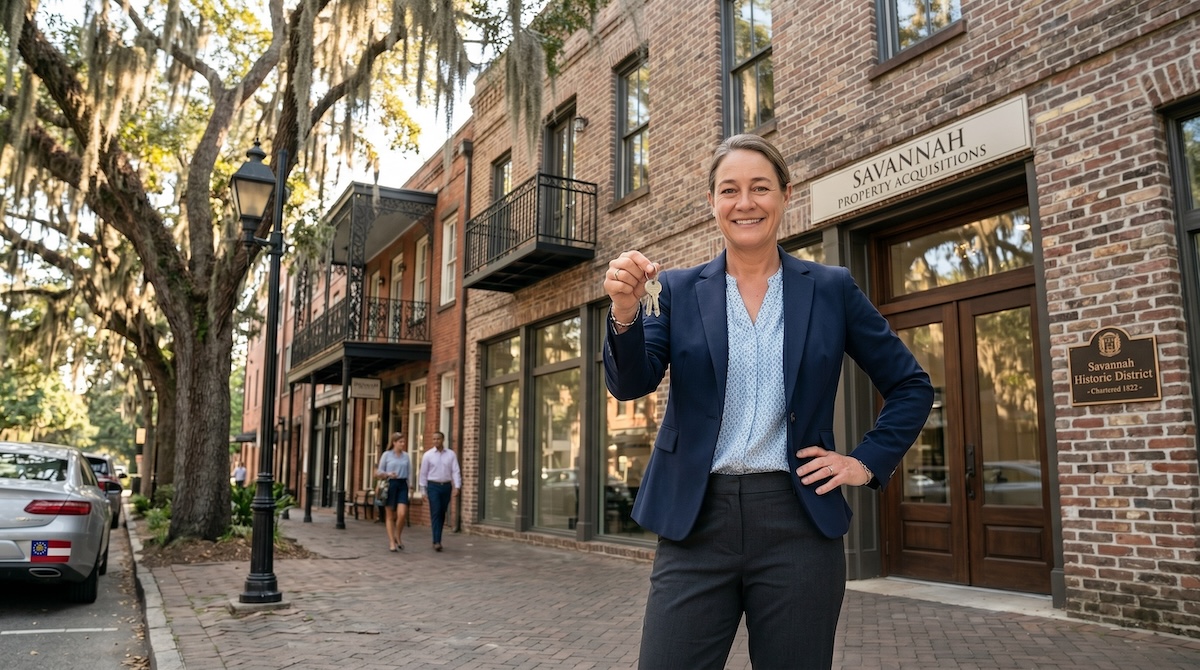
Savannah has a reputation that often gets in the way of the actual story. Yes, it is one of the most visited historic cities in the Southeast. But the Savannah that small business owners are operating in today is something significantly different from a tourism-and-preservation economy.
The Port of Savannah is the single-largest container facility on the East Coast, and industrial vacancy across the metro has sat near record lows, around 0.6%, for much of the past several years. More than 92 million square feet of industrial space anchors the region, and new logistics and distribution facilities continue to absorb space quickly. Amazon, Hyundai, Dermody Properties, and dozens of suppliers serving Hyundai's Bryan County Metaplant have all expanded their footprints in coastal Georgia over the past two years.
That growth is changing the commercial real estate equation for small business owners in the Savannah area. When you operate in a market growing this quickly, the question of whether to own or lease your space has real financial stakes attached to it.
Commercial space in Savannah is not as abundant or affordable as it once was. The market across major property types reflects a region where demand has consistently outpaced available supply.
In the office sector, average asking rents sit near $22 per square foot across all asset classes, with Class A space averaging closer to $26 per square foot and select Midtown buildings reaching $30 or more. Retail rents across the metro average around $20 per square foot, with premium locations on Broughton Street, in the Historic District, and near Oglethorpe Mall commanding meaningful premiums. Industrial and warehouse rents average around $6 per square foot NNN, with vacancy near historic lows and new speculative deliveries absorbed quickly.
These are not static numbers. The pending deepening and widening feasibility study for Savannah Harbor, ongoing Hyundai-related supplier expansion, and steady port volume growth all point to continued upward pressure on industrial and commercial space. A market growing at that pace does not produce softening rents.
For a small business owner sitting on a lease, that trajectory is worth taking seriously.
Renting commercial space in Savannah works well when you are uncertain about your location needs or in early stages of growth. But for established businesses with a stable customer base, a committed service area, or significant physical infrastructure, leasing carries a risk that rarely shows up on a profit and loss statement: rent escalation at lease renewal.
In a market with low vacancy and growing tenant demand, landlords hold most of the leverage when a lease comes up for renewal. A business that has invested years building a customer base in a specific location, that has built out a space to fit its operations, and that has a staff familiar with the surrounding area is not easily mobile. Landlords know this.
Owning your space eliminates that dynamic. Your occupancy cost becomes a fixed debt payment instead of a variable expense subject to renegotiation every three to five years. The dollars that previously went to a landlord start building equity in an asset you control.
There is also the question of what happens when your lease ends and the landlord has other plans. In a growth market like Savannah, commercial properties get redeveloped, sold, or repositioned regularly, particularly in the Historic District, along Victory Drive, and throughout the industrial corridors near I-95 and the port. Tenants in those situations have limited options. Owners do not face that uncertainty.
The most common reason small business owners do not pursue property ownership is straightforward: conventional commercial loans require 20% to 30% down. For a $750,000 building in Savannah, that is $150,000 to $225,000 in cash before accounting for closing costs, any needed renovations, or the working capital a business needs to keep operating.
The SBA 504 loan program was designed to address exactly that barrier.
The 504 is a three-party financing structure that works as follows:
Using the same $750,000 example, a 504-financed purchase might require as little as $75,000 down rather than $150,000 to $225,000 under a conventional structure. The SBA portion carries a fixed rate for the full loan term, up to 25 years for real estate. Unlike a conventional commercial loan with a balloon payment or rate adjustment after five to ten years, the SBA 504 portion is a true fixed-rate loan for its full duration.
That fixed-rate structure has particular value in an active growth market. When you finance the purchase of a building you plan to occupy for the next two decades, locking in a portion of your financing at a rate that cannot increase gives you the kind of cost predictability that a lease simply cannot offer.
The SBA 504 program covers a broad range of commercial property types that are common throughout the Savannah metro area, including:
The program also covers new construction and substantial renovation. If you are building a facility from the ground up in a submarket like Pooler, Port Wentworth, the Chatham Parkway corridor, or the growing areas of Effingham and Bryan Counties, the 504 can finance land acquisition, construction costs, and eligible soft costs within a single structure.
To be eligible, your business must operate for profit, have a tangible net worth under $20 million, and average net profit after taxes under $6.5 million for the two most recent fiscal years. Most small businesses in healthcare, professional services, light manufacturing, logistics, food service, and retail that are considering property acquisition will meet these thresholds.
A common concern among business owners exploring the 504 is timing. If you have a purchase contract, you need to know whether the financing can close on a realistic schedule.
The process moves in defined stages. It begins with a Business Development Officer reviewing the project to confirm eligibility. From there, the application moves through internal underwriting and documentation, followed by SBA approval, which typically takes around 14 days from submission. Closing generally follows within two to three weeks of SBA approval, with funding coming approximately 45 days after closing for standard acquisitions without a construction component.
Georgia Small Business Capital (GSBC) serves the coastal Georgia region and works through 504 transactions regularly in this market. GSBC has been administering the SBA 504 program for more than 35 years and has participated in more than $14 billion in projects across the Southeast. For Savannah-area business owners, GSBC's experience with the local lender community means your bank relationship does not need to be disrupted. The 504 is a collaborative structure, and GSBC's role is to work alongside your participating bank, not replace it.
SBA 504 fees total approximately 2.17% of the SBA loan amount. These fees are financed into the loan itself and do not require additional cash at closing, which is a meaningful distinction from some other loan programs where fees are paid out of pocket. An SBA-approved attorney handles the closing, with fees typically around $2,500, which can also be financed.
When you compare the total cost of a 504-financed acquisition against the cost of continuing to lease, the math is rarely close for a business that plans to stay in a location for ten or more years. You are essentially comparing a fixed, equity-building payment against an escalating rent that produces nothing at the end of your tenancy.
Savannah's growth fundamentals are not a short-term trend. Port volumes have grown steadily for more than a decade, the Hyundai Metaplant has kicked off a multi-year wave of supplier investment, and residential and commercial development in Chatham, Effingham, and Bryan Counties continues to attract institutional capital.
For a small business owner who has built something durable in this market, the decision to continue renting commercial space at escalating rates is worth examining honestly. The 504 program exists to make ownership accessible at a down payment that preserves the working capital your business actually needs.
Does the SBA 504 loan work for purchasing commercial real estate in Savannah?
Yes. The SBA 504 loan is specifically structured for owner-occupied commercial real estate and is available to eligible small businesses throughout the Savannah metro area, including Chatham, Effingham, Bryan, and Bulloch Counties. Property types commonly financed include office buildings, medical and professional suites, retail facilities, light industrial and warehouse space, and mixed-use properties. The key requirement is that your business occupies at least 51% of the building for an existing property, or at least 60% for a newly constructed one.
What is the minimum down payment for an SBA 504 loan in Georgia?
Most borrowers contribute 10% of the total project cost. Two situations typically require a 15% contribution: businesses that have been operating for less than two years, and properties classified as special-purpose (such as car washes, gas stations, or certain medical facilities). A GSBC Business Development Officer can confirm the exact down payment requirement for your specific project.
Can the SBA 504 loan be used for new construction in Savannah?
Yes. New construction is an eligible use of SBA 504 funds. The loan can cover land acquisition, construction costs, architectural and engineering fees, and other eligible soft costs within a single structure. Construction projects generally take longer to fund than standard acquisitions because funds are disbursed as construction progresses. GSBC's 504 Velocity Bridge Loan Program is designed specifically to provide interim financing and reduce risk during the construction phase, which helps keep deals on track until the permanent SBA debenture funds.
How does the SBA 504 interest rate compare to a conventional commercial mortgage?
The SBA 504 debenture portion of the loan carries a fixed interest rate for the full loan term, set based on the sale of government-guaranteed securities tied to the 10-year U.S. Treasury yield. The rate is fixed at the time of funding and does not change over the life of the loan. Conventional commercial mortgages frequently include balloon payments or rate adjustments after a set period, exposing borrowers to refinancing risk. The 504's fixed rate provides long-term cost certainty that most conventional structures do not.
How long does it take to close an SBA 504 loan for a Savannah commercial property?
For a standard acquisition without a construction component, the typical timeline from completed application to funding runs approximately 60 to 75 days. SBA approval generally takes around 14 days from application submission. Loan closing follows within two to three weeks of SBA approval, and funding comes approximately 45 days after closing. Having a complete application package and working with an experienced CDC helps avoid delays. GSBC's team works directly with Savannah-area businesses and participating lenders to keep the process moving on schedule.
Georgia Small Business Capital (GSBC) is a private, non-profit Certified Development Company serving small businesses across Georgia. GSBC administers the SBA 504 Loan Program and has been supporting Georgia business growth for more than 35 years. To speak with a GSBC loan officer about a Savannah commercial property purchase, call (404) 373-8601 or email info@ga504.com.